Antarctica
Wednesday 19 December

At sea. Went for our normal pre-breakfast stroll on deck, airtemp was 0.8 degrees, water 1.9 degrees, wind was force 6 with a 4m swell. There was a lot of spray around the bow. Went to a lecture about Deception Island (which is a collapsed volcano). After lunch, there was more vacuuming of clothes and disinfecting of muck boots – biosecurity before our Antarctic landings. There was also a lecture about William Smith, who discovered Antarctica in 1819. Broke one arm of my glasses, but managed to construct a fix from a paperclip and duct tape. Dinner (Swedish buffet). There were several snow showers, whale blow was seen frequently around the boat, and another boat (possibly Navy?) was visible on the horizon.
Clocks went back one hour this evening.



Thursday 20 December

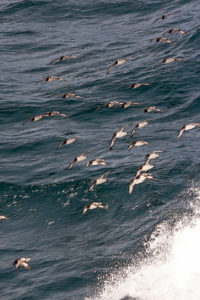
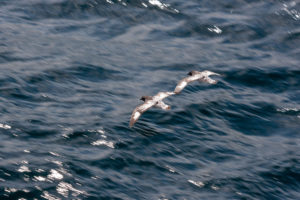
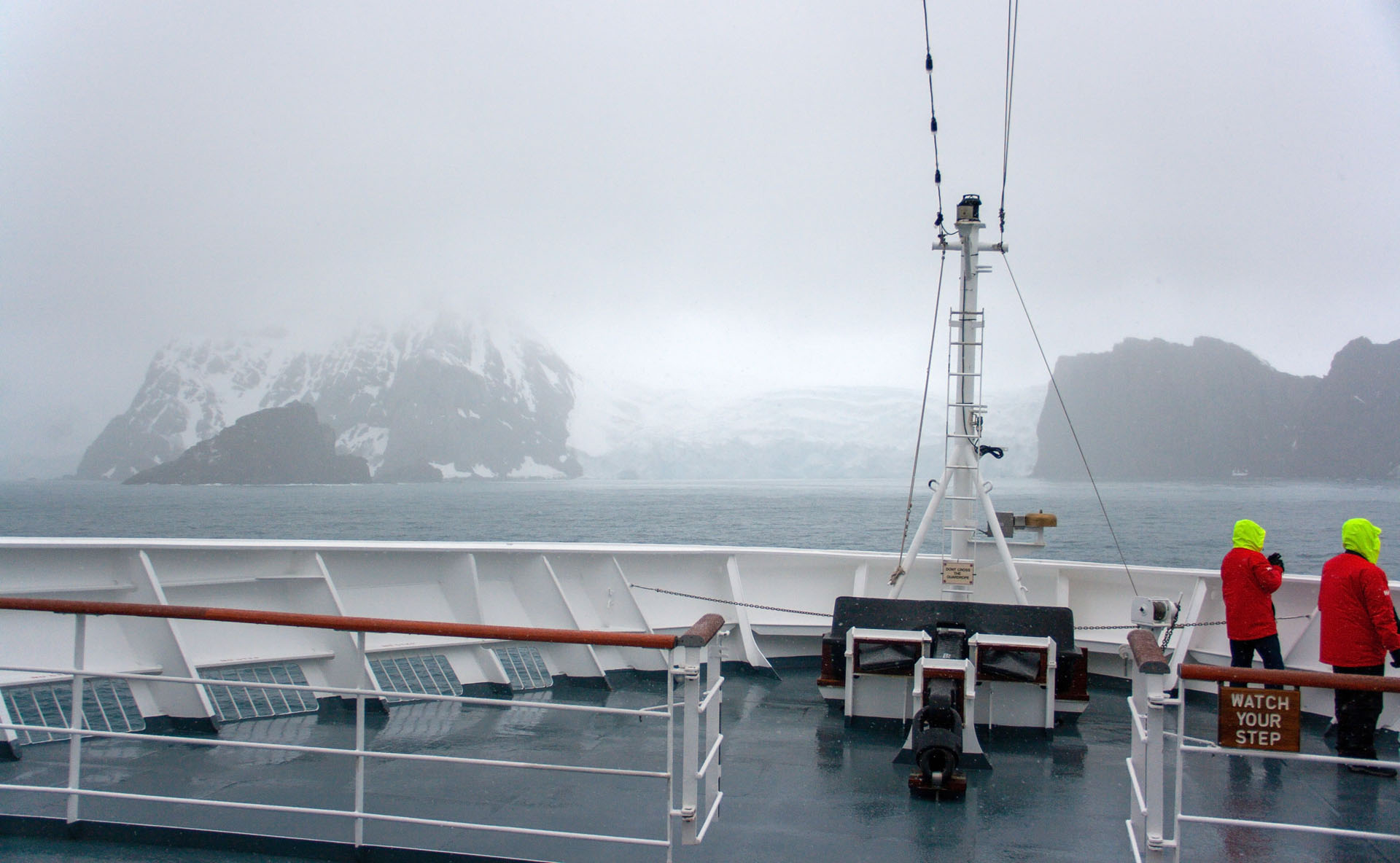
At sea. Swell 3m, wind force 5, air temp 0.7 degrees C, water 1.6. Water depth over 3000m (over the subduction zone between the Scotia plate and the South Shetland plate). Still lots of Cape petrels around the boat. We went to a second lecture on William Smith (mostly about a recreation of his voyage from Blyth in Northumberland). Also went to Natalia’s lecture on penguins. About midday there was an announcement that we were officially in polar waters, having crossed the 60 degree line of latitude. In the afternoon we went to a lecture with Stian about the original Fram and her first three expeditions – across the Arctic (frozen in the ice) with Nansen, to search for the NorthWest passage (also with Nansen – there was too much ice to get through the Passage, but part of NorthEast Canada was successfully mapped) – and to the Antarctic with Amundsen (South Pole expedition). Following afternoon tea we went to a lecture from Genna on Shackleton’s Antarctic expeditions (with Scott on the Discovery, then leading expeditions on Endurance and Quest). Huge flock of Cape petrels outside, and one albatross. Weather cloudy and dull by 6pm, although we had blue skies and sunshine for most of the day, and it started snowing early in the evening. We reached Elephant Island around 20:40, in very poor visibility. We saw some icebergs, some growlers and Point Wild! The captain appeared to bring the boat very close to shore (although it was difficult to tell how close we were, with nothing to judge scale). It was difficult to make out the memorial to the Captain of the Yelcho, who rescued Shackleton’s men from Elephant Island.


After dinner the draw for camping places was held in the lounge (30 places, but 60 passengers wanting to camp).
Friday 21 December (Summer Solstice)

At sea (though not in open water) in the Bransfield Strait and Antarctic Sound. Air and water temperature both 0.3 degrees, not much swell. Several icebergs around, also some humpback whales and a few penguins. There were lots of icebergs and growlers in Antarctic Sound, and a number of Adelie penguins porpoising. We went to a lecture by Helga on Nordenskold‘s Antarctic expedition.
We arrived at Brown Bluff at approx 1pm, in light snow. Everything very grey and white, with very little contrast (except sometimes some blue in the icebergs). The water was very still, with lots of penguins porpoising around. Soon after our arrival, the wind got up (resulting in our kayaking session being postponed), so we prepared for our landing on the continent of Antarctica.
At about 15:20, we were called down to the tender pit, and boarded the boat for the short trip to the beach. The beach was steeply sloping, and covered in large lumps (several feet across) of ice at the waterline, which the expedition team had had to clear to allow us to land.

Landing at Brown Bluff was .. interesting!
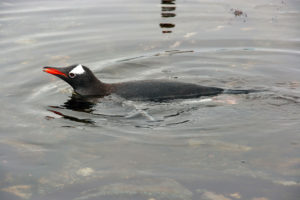
There were lots of Adelie and gentoo penguins around, plus some nesting petrels and kelp gulls. The penguins were waddling along the beach, coming in and out of the water and porpoising across the bay. We watched the penguins leaping onto the growlers, diving (not elegantly) off, and also slithering off (watched one leap out onto a berg, slither across the top waving its flippers to try and keep its balance, and fall off the other side). Sometimes the penguins looked as if they might get crushed by the ice as it shifted in the swell – much panicked flapping and scrabbling! Some chicks being fed (some of the penguins had two chicks). Some penguins headed for the water, dithered on the edge for a few moments, then decided it was too cold (or they’d glimpsed a leopard seal) and turned back to the beach.

Adelie penguins off for a swim, or maybe not.
It was snowing lightly when we landed, but this stopped while we were on the beach, and the sun tried (briefly) to come out, giving a better view of the cliffs. We had about an hour and a half ashore, and the snow had restarted by the time we left. It was not easy to get back in the boat, but the expedition team did a great job (up to their waists – or even their necks – in the water, fending off the ice and steadying the boat). The tender boats had to make their way through floating pieces of ice – there was a lot of noise when they hit them!
We left Brown Bluff and sailed back up Antarctic Sound towards Bransfield Strait and Deception Island. As we passed Hope Bay and Esperanza Station (Argentine base) we had some stunning views of the Antarctic landscape – and the sun came out through the clouds (a little bit of blue sky appeared). It was difficult to tell where the hills ended and the clouds started. There were lots of icebergs, penguins porpoising and some whales.


We passed out of Antarctic Sound well before sunset, by this time the wind had got up and there was lots of spindrift from the edges of the ice.
Lingonberry icecream for dinner – good sharp flavour.
Saturday 22 December

Up at 6am for our normal deck promenade – and also for a view of Deception Island. We watched as we passed through Neptune’s Bellows into the caldera. This is a reasonably wide gap – but there is a submerged rock in the middle, so we passed very close to one side.
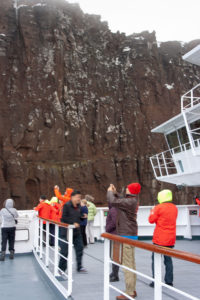
Passing through Neptune’s Bellows into the vast caldera.

The caldera of Deception Island.
The rock formations were very spiky and dramatic, with lots of snow on the edge of the crater. The Ocean Nova was waiting to make her way in, and on to Whaler’s Bay, as we headed for Telefon Bay.
Kayaking was cancelled – too much wind again.
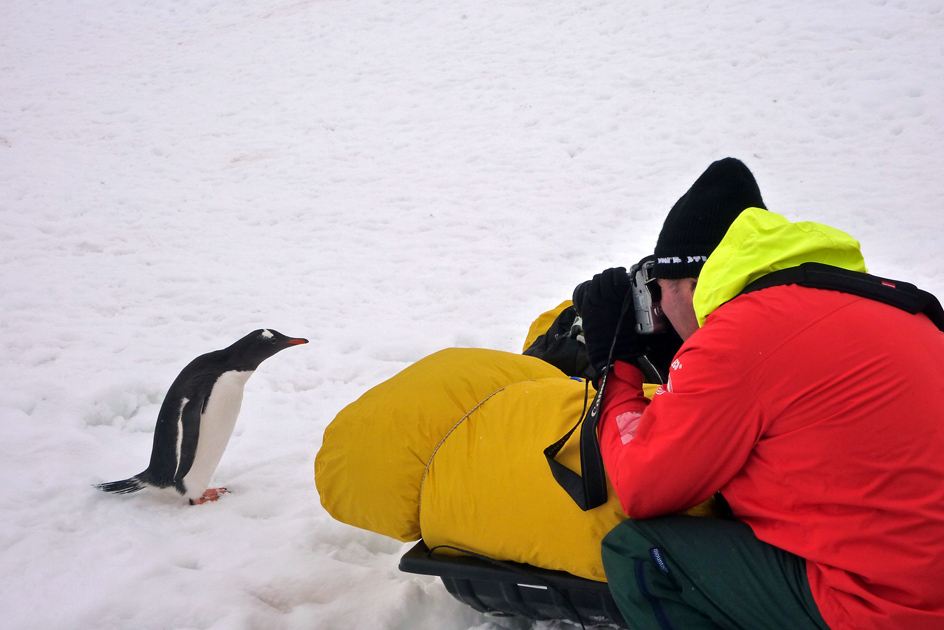
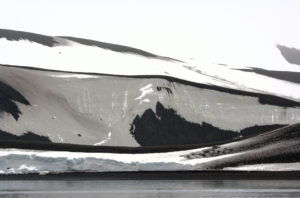
We landed at Telefon Bay before 9am. There were a couple of crabeater seals sprawled on the beach, which had a very dark surface, ash and rock, striated with snow. A walk was marked out for us around a mini-caldera (or vent), unfortunately low cloud prevented us getting a view from the highest point (185m), although we could see Fram down in the bay, plus various small lakes in the craters. The slopes were steep, and the surface was quite loose, so we got very hot walking. When we arrived back down at the beach, one small and lonely-looking gentoo penguin had emerged from the water. There is not much wildlife in Deception Island, volcanic acivity keeps the water temperature higher than the surrounding area.
Over lunch, Fram sailed across to Whaler’s Bay (there was no icecream at lunch, causing a certain amount of aggrieved muttering!). Kayaking was still cancelled due to the wind, so we landed on the beach, and walked along to the end, past a couple of chinstrap penguins, and a leopard seal (missing one back flipper) asleep on the sand. We then walked up to Neptune’s Window – a gap in the main caldera – which has spectacular views and a sheer drop (a small rockfall as we reached the Window encouraged us to keep well clear of the edge, which looked pretty unstable!). There were a couple of Cape petrels flying about, and some lichen on the rocks. We walked back down and along the beach to the landing site – lots of ruined buildings about, abandoned boats and whale bones.
Back at the landing site people were being checked by the doctor for the Polar Plunge – a surprising number of people participated, and even more surprisingly some actually managed to swim! The water was approx 7 degrees (due to thermal activity – it was about 1 degree outside the caldera), scraping away the sand at the water’s edge allowed warm water to seep through. Although we’d had blue sky for our arrival, it now started to snow gently, gradually becoming heavier (the wind increased too). The landcape around the bay was very bleak, like an icy version of Mordor. The crew had taken advantage of a (relatively) sheltered spot to lower one of the lifeboats into the water, and take it around the bay.






Dinner was Filipino-themed (the officers on board were Norwegian, but the rest of the crew were Filipino), and icecream was available (apparently we’re being rationed, icecream will no longer be available at lunch, as we’re eating it too quickly!).
Sunday 23 December

Sailed back to the Antarctic Peninsula overnight, and spent the morning cruising Wilhelmina Bay (no landings). Temperature just above zero, skies grey and overcast, with some snow falling, and quite windy. Wildlife included humpback whales, an iceberg with a leopard seal on it and an iceberg with a couple of penguins. Several glaciers were visible, with lots of blue-tinted ice and icebergs. The wind dropped by mid-morning (it had been very cold in the snow and wind earlier, we’d had to thaw out several times with hot chocolate!). We also passed another ship, ‘Island Sky’.


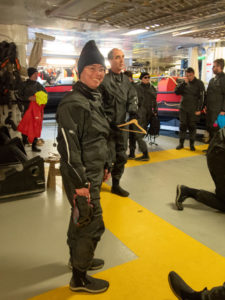
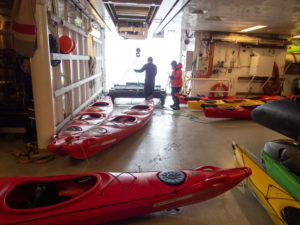
We arrived at Orne Harbour at lunchtime. Landing here involved a steep climb 150m up a snowslope to a colony of chinstrap penguins (they need to nest on rock, and the snow melts first on the ridge). Kayaking finally happened (so we didn’t actually land here) – we went down to the tender lobby in our thick socks and thermal underwear, to be kitted out with a thermal onesie (very flattering!), a thermal dry suit (with airtight seals at the wrists and neck) and neoprene booties. Gloves (mittens) were attached to the paddles. The kayaks were lowered onto the water out of a hatch, all tied together, and we got into them from the tender pit (a special pontoon had also been provided for this, which made it relatively easy to get into the kayaks. Sea-ice was forming in the water, smoothing out the swells, and there were also a lot of small broken bits of ice in the water, which made keeping a paddling rhythm difficult. The kayaks were two-person, with a rudder (the person at the back steered). There were a few penguins in the water, but otherwise not much wildlife. We could hear the noise (like thunder) and (a few minutes later) feel the waves when one of the large glaciers calved. Visibility was not great, it snowed gently (but continually) – a total of approx 10cm by the time we’d finished kayaking – which accumulated on us, on the kayak and IN the kayak (no spray decks!). We were shown how to ‘raft’ the kayaks – this was cold, as we had to take our hands out of the mitts to keep the kayaks together.
We did a bit of ‘formation paddling’ for the benefit of Genna (Ship’s photographer), paddled past the landing site, and further on to a large rock pinnacle (I think it’s at the entrance to the bay, but in the poor visibility it was difficult to tell). There were lots of terns here – they nest on the rocks – and we could hear them. We then paddled back to the Fram and de-kayaked – with difficulty as after more than 2 hours legs were very stiff and feet frozen! Once back on board we were greeted by one of the crew, manning a tea urn – he also had a bottle of rum in one hand, and brandy in the other, to put in it!


The post-dinner daily briefing was disrupted due to whale sightings midbriefing!
General:
Shore trips are always accompanied by a member of the medical team (the crew included a doctor and nurse). Due to IAATO restrictions, cruise ships can only land a maximum of 100 people at a time in South Georgia (outside Grytviken) and Antarctica, so food, water and shelter for 100 people for 24 hours was also always brought ashore, in case there were problems getting back to Fram.
Monday 24 December

Arrived Melchior Islands approx 7:30. Passed the Argentine Melchior base. The deck of the Fram was quite slippery – yesterday’s snow had been cleared – but not from the Observation Deck). Air temp 0.5 degrees, water temp 1.6 degrees.
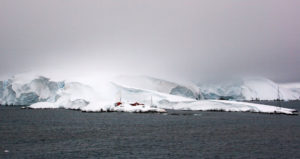
Heavily overcast sky on arrival at the islands.
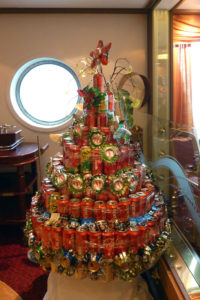
Crew had created wonderful Christmas decorations – all displayed near the restaurant. The Christmas tree in the Panorama lounge also looked very good, with decorations created by the passengers while cruising Wilhelmina Bay yesterday. Christmas decorations had been going up gradually all over the boat since leaving Ushuaia – with the Christmas trees firmly tied to the ceiling to avoid accidents in rough weather!


There were no landings at the Melchior islands, just a tender boat cruise, and as we were in the last boat group we had to wait for a while. It was very dull and overcast when we eventually left Fram. We saw a crabeater seal (on an iceberg), a Wedell seal on a rock, kelp gulls, imperial cormorants and some penguins. Lots of snow formations on the islands, plus lots of icebergs in the water (these came from elsewhere – the snow on the islands is not compacted enough – because not old enough – and so tends to crumble when it hits the water). The sky began to clear while we were out – we could see distant mountains with blue sky and sunshine.
We were back on Fram just in time for lunch, and started heading South between Brabant Island and Anvers Island in glorious sunshine, with amazing views. There was a band of smog-like cloud ahead (possibly caused by water evaporating from the sea), and while the sea had been quite choppy while we were out in the tender boats, it now became smooth and oily-looking. Saw a whale blow, and also animals (penguins?) in the water. The scenery was incredible as we headed down the Gerlache Strait and into the Neumayer Channel.

Sunshine in the Gelache Strait.
The sun shone, there were dramatic views of mountains and glaciers (we arrived here later than expected, having had to apply a speed restriction to make sure we didn’t hit any whales). A group photo of all passengers was taken on the bow (Genna having ascended to the walkway in front of the bridge to take it). We passed Port Lockroy (Quark ship moored in the bay to the North of Port Lockroy – looked like a group had gone snowshoeing). Trying to look in all directions simultaneously to properly admire the scenery was very difficult (and trying to photograph it was worse!).
An extra effort had been made with the cakes at afternoon tea for Christmas Eve, and at dinner we were greeted with a glass of prosecco (or apple juice).

Cakes laid out for afternoon tea.
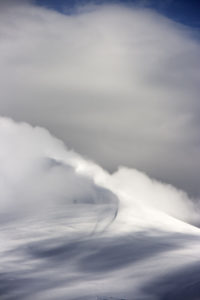
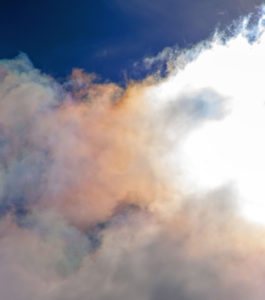
Shortly after 7pm we crossed the 65 degree S line of latitude, and entered the Lemaire Channel, unfortunately the cloud was now much lower than earlier, although it was still very light (sunset due at 00:22 – and sunrise at 02:32). Saw the Hanse Explorer exiting the Lemaire Channel, the channel was very icechoked, but the scenery was spectacular (when visible through the low cloud).

Passing through the Lemaire channel.
There were a number of crabeater seals visible on icefloes. The narrowest point of the channel was partially blocked by an iceberg, and we had to wait here for another ship (Ortelius) to come through.




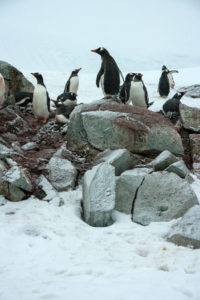
These delays (ship proceeding cautiously due to ice in the channel, and whales earlier) meant we did not arrive at Peterman Island till 21:45. The expedition team at once went ashore with pulkas (sleds), tents and sleeping mats, and we followed at 22:20. Having landed, we collected our pulka, added the sleeping bags to the load and hauled the sled a few hundred yards to the campsite. Having trampled the snow flat(ish) to make a platform, we put up the tent. Helga then took us for a walk around the island – over to the memorial to three BAS staff who died in 1982 crossing sea ice to Faraday Station, up the hill for a view of iceberg alley, and a scree slope where Wilson’s Storm Petrels were nesting. There were lots of penguins everywhere (mostly gentoo, but a few Adelie), perched on rocks, tobogganing across the snow, waddling around the campsite – and discussing their new, temporary neighbours at great volume! Having been shown how to use the porta-potties (in an especially dug toilet area – even with a toilet roll holder) we tucked up in our polar sleeping bags. We could hear the snow falling softly on the tent, and the yarping of the penguins. Fortunately there was no need to notify Santa of our whereabouts, as a present had been left in our cabin before we left Fram.




Tuesday 25 December

It was barely dark (just dusky) as we settled down to sleep at 1am, so it stayed fairly light in the tent. The ground was surprisingly hard, my feet were a bit cold, but we slept for a few hours, waking to the noise of penguins and snow. Got up around 5am, went for a walk in the vicinity of the campsite.

Happy Christmas campers.
Overnight the bay where we had landed had filled up with brash ice overnight (it had been filling up the previous evening). We could hear a glacier calving across the bay. We struck camp, repacked the pulka and hauled back down to the landing site (the path through the snow was now well trodden, and becoming compacted and slippery, though it was still possible to ‘fall’ through to knee-depth or more). Watched the penguins trying to steal stones (for their nests) from each other, and some other penguins mobbing a skua.
We had been due to be collected by the tender boats at around 6:30, but they were unable to get through the brash ice, we would have to wait for the tide to shift it. After we had been waiting for a while (feet getting increasingly cold!) Helga and Felipe went off to investigate an alternative landing site (on the other side of the campsite) – this proved feasible (they returned with Manuel, who had landed from a tender boat), so the pulkas were hauled back to the campsite, and on to the new landing site (this was harder, as it was a new, uncompacted path).
Unfortunately only two tender boats had come over, so only half the group could be retrieved immediately. Having asked for volunteers to stay for another hour or so, the first group made a slightly awkward descent over rocks to the boat, which was in a small inlet clear of ice (as it was clear of ice, it was also full of swimming penguins: the original landing being icechoked, penguins could not get in the water there – although there was one confused looking penguin standing on ice in the bay!). The tender boats had to go very slowly through the thick brash ice, with the larger one in front and the smaller following closely behind.


Fram’s decks were crowded with people watching the rescue (everyone else had been due to land that morning, but owing to the ice the landing had been cancelled). Arrived back around 9am, with Ian following in the second group at around 10am. The restaurant was still open for breakfast – usual buffet, plus a special breakfast of cheese omelette, bacon and beans for the campers.
Once everyone was back on board, the boat cruised very slowly to our final landing – Pleneau Island. The scenery on the cruise was spectacular, the weather was cloudy with hints of sunshine. After lunch (turkey buffet), we arrived around 2pm. Landings commenced (but part way through Fram had to reposition, to clear some of the accumulation of brash ice so the tender boats could still get between ship and shore. There were lots of penguins around the ship, they like the icefree areas, plus the bow and stern thrusters stir up the krill. The landing site was on a rocky beach, with snowcovered slopes behind (these were out-of-bounds, due to the snow depth). There were lots of gentoos on the beach, and on rocks emerging from the snow, coming and going between nests and sea. One slope looked like a penguin piste, so many were going up and down. The water was very clear, we could watch the penguins waddle in, then dive underwater and vanish at lightning speed as they headed for the open sea. There was also a Weddell seal out on the snow. We were back on the Fram around 6pm, and after dinner went straight to sleep – could not stay awake any longer, after just a few hours sleep while camping!